

Identities have become one of the company's biggest vulnerabilities
Many companies still view IT security as something that revolves around firewalls, antivirus software, endpoint protection, and strong passwords. While these measures remain important, they are no longer enough.
In modern IT environments, identities have become the very infrastructure that connects systems, cloud platforms, applications, employees, vendors, and automated processes. Every user, administrator, service account, API key, machine identity, and AI agent has access privileges. And each of these identities can potentially become a point of entry for an attack.
This makes identity security an area that companies cannot treat as a routine IT task. It is a business-critical security discipline.
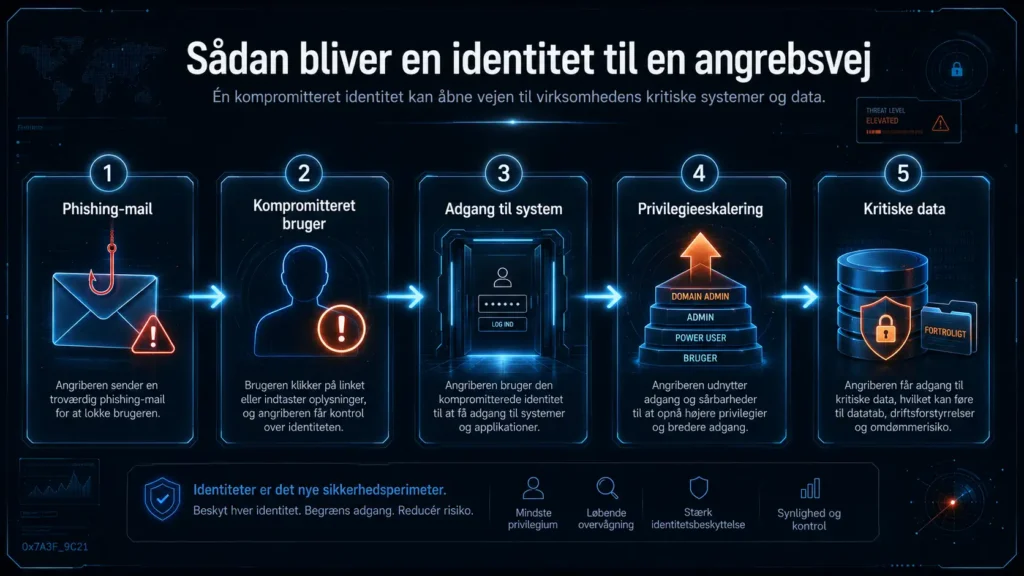
What is identity security?
Identity security involves protecting, monitoring, and managing all digital identities and their access rights across the company's systems.
This includes, among other things:
- Employee accounts
- Administrator roles
- Service accounts
- Cloud identities
- API keys
- Machine Identities
- External users
- AI agents and automated workloads
The goal is not merely to ensure that the right people can log in. The goal is to ensure that no user has more access than necessary, and that compromised accounts cannot be used to gain further access within the organization.
Why identity security is more important than ever
Attackers don't always need to use sophisticated malware to gain access. Often, all they need to do is obtain a legitimate identity.
This can happen through phishing, social engineering, reused passwords, session hijacking, leaked API keys, or compromised devices. Once an attacker gains access to an account, their activity often mimics normal user behavior. This makes the attack harder to detect.
The problem becomes more serious when an identity has access to more systems than necessary. An ordinary user may have indirect access to a group, a role, or a cloud resource that leads to sensitive data. In this way, a single instance of seemingly limited access can become the first step in a larger compromise.
Identity security is about attack vectors, not just access
Many companies have a clear understanding of who has access to what, at least on paper. But fewer have a clear picture of how access rights are interconnected across different environments.
This is precisely where the risk arises.
An employee account can be a member of a group. The group can have access to a system. The system can be connected to a cloud account. The cloud account can have access to production data. Each individual permission may seem acceptable on its own, but taken together, they can create a direct path to critical assets.
That is why companies should ask a different question than simply:
“Who has access?”
The more important question is:
“What can an attacker do if this identity is compromised?”
Users with excessive privileges significantly increase the risk
One of the most common problems in companies is overly broad access rights. This often happens gradually.
An employee is granted access to a project. The project ends, but the access is not revoked. A developer is granted temporary cloud permissions. The role is never updated. A service account is granted administrator permissions to make an integration work. No one follows up.
Over time, a landscape of access emerges in which many identities have more rights than necessary.
This creates three key risks:
First, attackers can achieve greater impact through a compromised account.
Second, it becomes harder to detect abuse because actions are performed with legitimate privileges.
Third, compliance and documentation become more complex, especially for companies subject to NIS2, ISO 27001, or other security requirements.
The cloud, hybrid environments, and AI are making identity management more complex
In the past, many identities were centralized around Active Directory and internal systems. Today, companies often operate across Microsoft 365, Azure, AWS, Google Cloud, SaaS platforms, APIs, remote access solutions, and automated workflows.
This means that identities are no longer limited to humans.
Machines, scripts, integrations, and AI-based tools can also access systems and data. These non-human identities are often overlooked because they do not fit into traditional user management.
But they can be just as critical as an administrator account. In some cases, they are even more critical because they run continuously, have broad privileges, and are rarely reviewed with the same thoroughness as employee accounts.
Identity security and phishing are closely linked
Phishing remains one of the most effective methods for compromising identities. When an employee is tricked into revealing login credentials, approving a fake MFA request, or opening a malicious file, the attacker can gain access to the company’s environment using a legitimate user profile.
That is why identity security cannot stand alone as a technical discipline. It must be combined with awareness training and phishing simulations so that employees learn to recognize the methods attackers use to steal identities.
Test and build your organization's resilience with phishing training.
How Companies Can Reduce the Risk of Identity-Based Attacks
A robust approach to identity security requires technology, processes, and behavior. It is not about a single solution, but about an overall level of security.
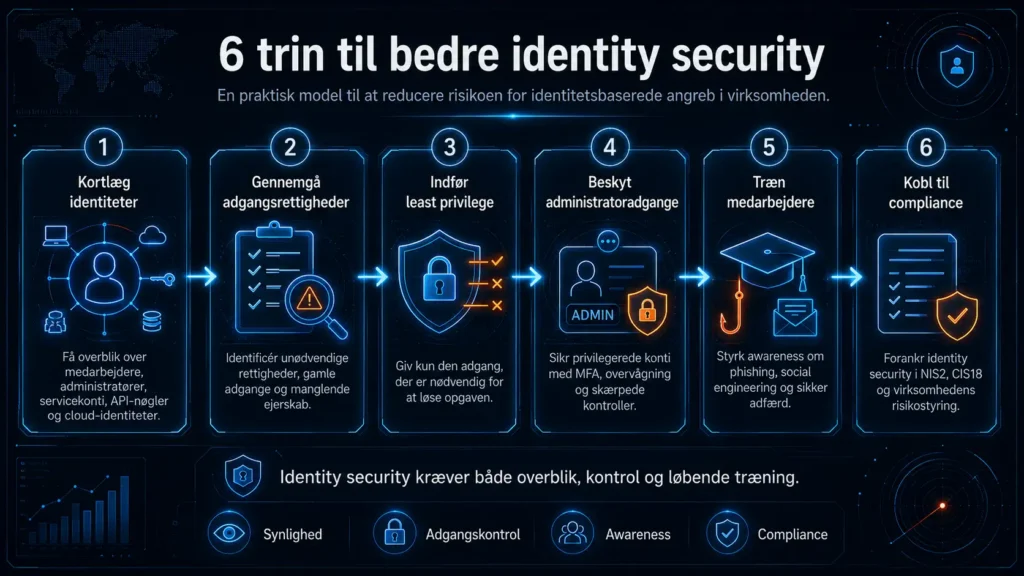
1. Identify all identities
Start by getting an overview of both human and non-human identities. This includes employees, administrators, service accounts, cloud roles, API keys, and integrations.
Without an overview, it is impossible to assess the risk.
2. Review access rights on an ongoing basis
Access should not remain permanent simply because it was once necessary. Companies should systematically conduct access reviews, implement role-based access, and remove unnecessary permissions.
3. Implement the principle of least privilege
Least privilege means that users and systems are granted only the permissions they actually need. This minimizes the impact if an account is compromised.
4. Take extra care to protect administrator access
Privileged accounts should have stronger controls, separate monitoring, MFA, logging, and clear procedures. Administrator access is often the quickest route to critical systems.
5. Train employees on phishing and social engineering
Technical controls can reduce the risk, but employees remain a crucial line of defense. Training makes it harder for attackers to gain initial access.
6. Link identity security to compliance
For many companies, identity management is also part of their compliance efforts. NIS2, CIS18, and other frameworks set requirements for access control, risk management, incident response, and organizational security measures.
Get your security efforts organized with NIS2 compliance.
Work systematically with controls and maturity through CIS18 compliance.
Identity security should be a management priority
Identity-based attacks are not just a technical problem. They can lead to service disruptions, data breaches, financial losses, compliance violations, and damage to a company’s reputation.
Therefore, identity security should be an integral part of the company’s overall risk management. Management should ensure that there are clear roles, established processes, and ongoing monitoring of access rights and employee training.
It’s not about eliminating all risk. It’s about reducing the likelihood that a single compromised identity could lead to a serious security incident.
Identity security is essential to modern cybersecurity
Identity security has become an essential part of companies’ defenses against cyberattacks. When identities, roles, and access rights connect people, systems, cloud environments, and automation, a single compromised account can quickly become a gateway to critical data.
Danish companies should therefore focus their efforts on access control, the principle of least privilege, regular access reviews, awareness training, and phishing simulations. This leads to improved security, stronger compliance, and a more resilient organization.
Want to know how much awareness and phishing training will cost your organization? Try SecureFirst’s price calculator.