AI Phishing: When a Single Wrong Click Can Trigger a Serious Security Breach
AI-powered phishing makes it harder for employees to spot fake emails, messages, and login pages. For Danish companies, this means that cybersecurity isn’t just about filters and firewalls, but also about training, preparedness, and a rapid response when the first employee falls victim.
A single click doesn’t have to lead to a major security breach. But it requires the company to have prepared its people, processes, and technology.
AI phishing has become a real business risk
For many years, phishing has been one of the most effective methods for gaining access to corporate systems. What’s new is that artificial intelligence makes these attacks more convincing, more targeted, and much faster to produce.
Whereas phishing used to be characterized by spelling mistakes, awkward phrasing, and obvious red flags, AI-generated messages today can mimic internal writing styles, managers, suppliers, and familiar workflows. This means that employees can no longer always rely on the classic warning signs.
This poses a critical challenge for the company: How can it ensure that a single wrong click doesn’t lead to data loss, system downtime, or compromised accounts?
ENISA’s Threat Landscape 2025 indicates that phishing continues to play a central role in many cyberattacks in Europe, and that the threat landscape is becoming more complex and targeted.
Why “the first employee affected” is crucial
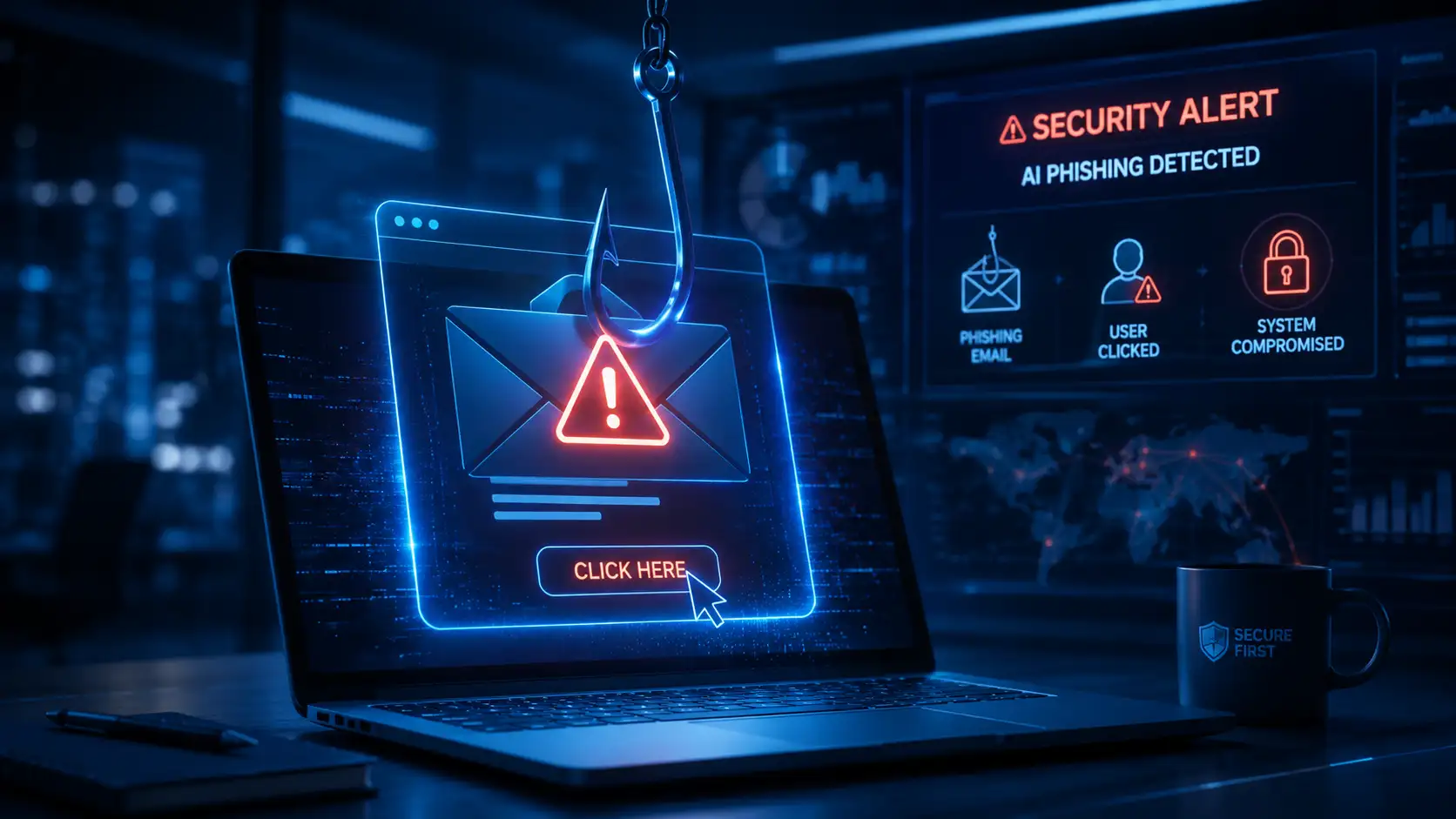
In many cyberattacks, the incident begins with a single user. This could be an employee who clicks on a link, downloads a file, approves a fake MFA request, or enters login credentials on a fake page.
The first compromised user often serves as the gateway to the rest of the organization. From there, the attacker may attempt to:
- steal login credentials
- access email accounts
- move on to other systems
- identify sensitive data
- abuse trust within the organization
- prepare ransomware or extortion
That’s why modern phishing protection isn’t just about preventing all clicks. It’s also about limiting the damage when a click does occur.
AI phishing requires a new approach to awareness
Traditional awareness training has often focused on teaching employees how to spot suspicious emails. While this is still important, it is not enough.
AI phishing requires employees to learn how to assess context, behavior, and risk. They need to be able to ask questions such as:
Does this message seem unusually urgent?
Does the request follow standard procedures?
Is the sender asking me to break an internal rule?
Am I being asked to log in via a link I didn’t seek out myself?
Does this involve money, data, access, or confidential information?
This makes safety awareness more practical and behavior-based. The goal is not to turn every employee into a safety expert. The goal is to instill sound safety habits in everyday life.
CTA: Improve employee safety behavior with awareness training
Read more here: https://securefirst.dk/awareness-traening/
AI phishing must be tested using realistic phishing simulations
Companies cannot assess their actual phishing risk based on policies alone. The risk only becomes apparent when employees are confronted with realistic scenarios that resemble the attacks the organization might actually face.
Phishing simulations provide answers to important questions:
- What types of messages do employees click on?
- How quickly do they report suspicious messages?
- Which departments have the greatest need for training?
- Is the company's internal reporting process working effectively?
- Does learning improve over time?
This makes phishing training a measurable security tool, not just a compliance activity.
Test your resilience with phishing training
Technology alone cannot stop an AI-driven attack
Email filters, endpoint protection, MFA, and access control are essential layers of security. However, no technical solution can completely eliminate the risk.
AI phishing exploits precisely those gray areas where technology may struggle to distinguish between legitimate and manipulated communications. A message from a compromised vendor account may look genuine. A fake Microsoft 365 page may resemble the real one. A message in Teams or via text message may feel more personal than a traditional phishing email.
Therefore, companies should operate on the assumption that a phishing click will happen at some point. The crucial difference lies in what happens afterward.
A mature approach should include:
- ongoing awareness training
- phishing simulations
- robust access control
- segmentation and restricted rights
- prompt reporting by employees
- clear incident response processes
- a safety culture embedded in management
AI Phishing and NIS2: Document that you are taking a systematic approach
For organizations subject to NIS2, cybersecurity is no longer just an internal IT matter. It is a management and documentation responsibility.
Among other things, NIS2 sets out requirements for cybersecurity measures and incident reporting for covered companies and public authorities.
This means that organizations must be able to demonstrate that they have a structured approach to managing risks, procedures, emergency preparedness, and continuous improvement. Awareness training and phishing simulations can be an important part of this effort because they address one of the most common risks in everyday operations: human manipulation.
It’s not about placing the blame on the employee. It’s about providing the employee with the right conditions to work safely.
What should companies do now?
Companies should treat AI phishing as a tangible operational risk. This requires a combination of prevention, training, and preparedness.
Start by identifying where phishing attacks are most likely to target your organization. Is it the finance department, customer service, management, HR, or employees with access to sensitive data? Then assess whether your training and technical controls align with the current threat landscape.
A practical action plan can consist of five steps:
- Conduct realistic phishing simulations.
- Train employees in specific decision-making situations.
- Make reporting simple and transparent.
- Define a clear process for rapid response.
- Track your progress and repeat the workout regularly.
The best protection comes when employees, technology, and processes work together.
AI phishing must be addressed before that first click becomes costly
AI-powered phishing makes cyberattacks more convincing and harder to detect. That is why companies should not only focus on preventing clicks, but also on mitigating the consequences when a click does occur.
Through awareness training, phishing simulations, clear processes, and robust preparedness measures, Danish companies can significantly reduce their risk. AI-powered phishing is not merely a technical challenge. It is a business-critical security issue that requires action across the entire organization.