
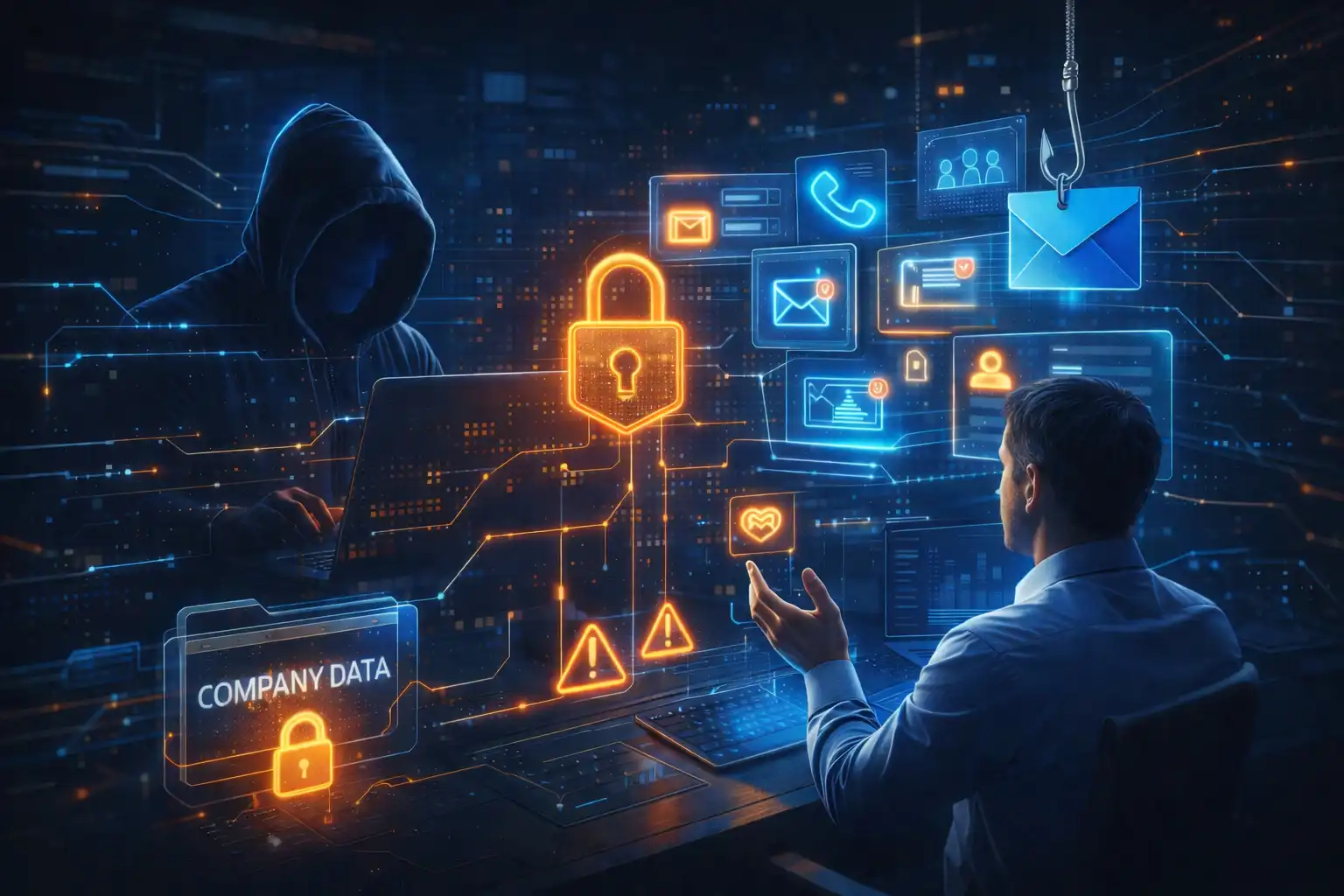
Social engineering is a growing threat to corporate cybersecurity.
Cybersecurity is one of the biggest challenges facing businesses and organizations today. Many people imagine that cyberattacks primarily occur through technical vulnerabilities in systems, but in reality, many attacks start somewhere else entirely—with employees.
Cybercriminals are increasingly using social engineering, where they manipulate people into opening the door to a company's systems themselves. This can be done through emails, documents, links, or messages that appear credible and relevant.
Once an employee interacts with a fake message or opens an attachment, the attacker can install malware or gain access to the company's network. That is why social engineering is one of the biggest risks to corporate cybersecurity today.
What is Social Engineering in Cybersecurity?
Social engineering is a method where attackers exploit human behavior rather than technical weaknesses.
Instead of hacking systems directly, they try to get employees to perform actions that compromise the company's cybersecurity.
This could be, for example:
- open an attachment
- click on a link
- download a document
- provide login details
- approve an access request
The attacks are often designed to create a sense of urgency or authority, so that the recipient responds quickly without asking questions.
The easiest solution is our all-in-one solution – NIS2 Compliance
Why social engineering is so effective
Even companies with strong technical cybersecurity can fall victim to social engineering.
The reason is simple. The attacker is not trying to break into the system; they are trying to get an employee to let them in.
An email may, for example, resemble a message from:
- a business partner
- a supplier
- a public authority
- an internal department
When communication seems legitimate and the content fits into a busy workday, it is easy to overlook the warning signs.
That is why employees are often the first target in modern cyber attacks.
Read more about effective awareness training for employees
This is how a typical attack on corporate cybersecurity works
A social engineering attack typically consists of several steps.
First, the attacker identifies a person or group of employees within the organization. Then, a message is sent that is designed to appear credible and relevant.
The message often contains:
- an attachment
- a link
- a document to be reviewed
- an urgent message
When the recipient opens the file or clicks on the link, malware may be installed, or the attacker may gain access to the company's systems.
In some cases, the compromise happens immediately. In other cases, a more discreet access point is established so that the attacker can move further into the network over time.
Do your employees know what signals to look out for? Read more about our Phishing solution that empowers your employees and trains them to be aware of incoming phishing emails.
Signs of social engineering attacks
Even sophisticated attacks often contain small warning signs.
Employees should be aware of:
- unexpected attachments
- emails requiring urgent action
- messages from senders that seem almost real
- links leading to login pages
- unexpected documents or downloads
The earlier these signs are detected, the better the company can protect its cybersecurity.
How companies strengthen their cybersecurity
There is no single solution that can stop all social engineering attacks. Effective cybersecurity requires a combination of technology, processes, and employee awareness.
Companies should focus particularly on the following areas.
Awareness training for employees
Employees are a key part of a company's cybersecurity. That's why organizations should invest in ongoing training that helps employees recognize phishing, manipulation, and fake messages.
Strengthen employees' understanding of cybersecurity
Social engineering often targets employees first. With the right awareness training, organizations can significantly reduce the risk.
Read more about our awareness training
Stronger technical security layers
Technical security systems can detect or stop attacks even if an employee clicks on a link.
Examples include:
- mail filtering
- endpoint security
- network monitoring
- threat detection
These solutions can be crucial in protecting your company's cybersecurity.
What does better cybersecurity cost your business?
Get a quick indication of what it will cost to strengthen your cybersecurity.
Calculate and get the price immediately
Cybersecurity requires a focus on both people and technology
Social engineering clearly shows that cybersecurity is not just about systems and software. People play a crucial role in both attack and defense.
When companies combine technical security solutions with awareness training and clear processes, the organization becomes much better equipped to withstand modern cyber threats.
The earlier an attack is detected, the less damage it can cause.
That is why a structured approach to cybersecurity is crucial for modern businesses.
Reducing risk requires a combination of awareness, technical security measures, and clear processes. This is where resilience is created.