
Phishing Simulation
Realistic phishing emails with immediate feedback, so employees learn to spot attacks in real-world scenarios—and you can track clicks, progress, and results all in one platform.
Realistic phishing tests with multiple difficulty levels
Instant feedback if an employee clicks
Automated campaigns and reports
Overview of click-through rates, departments, and trends
Fixed and transparent pricing with no hidden fees
* Try a free phishing simulation.
















Phishing Simulation – In a Nutshell

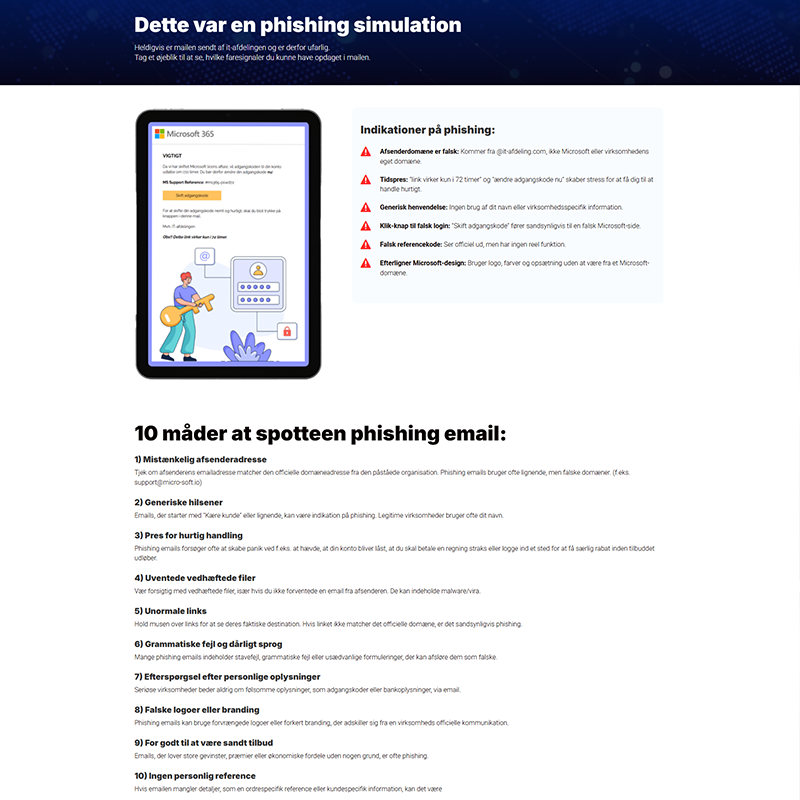
Can you spot all the phishing indicators?
What are phishing simulations
Phishing simulations are realistic but harmless test emails designed to train employees to recognize phishing in their daily work. With our solution, you get automated phishing tests sent out every month from over 30 realistic domains and at various levels of difficulty.
Why Do Phishing Tests Work?
Employees encounter emails that mimic the latest attacks and receive immediate feedback upon clicking, ensuring effective learning retention.
Get started easily with phishing training
Onboarding requires only a brief meeting, during which we assist with setup and a dashboard walkthrough. Subsequently, everything operates automatically.
A comprehensive overview of the results
Within the dashboard, you can monitor click-through rates and track progress down to the individual employee level. Automated reports for management clearly indicate where risks reside and how the organization is improving.
Test and improve employee attention
What is a phishing simulation?
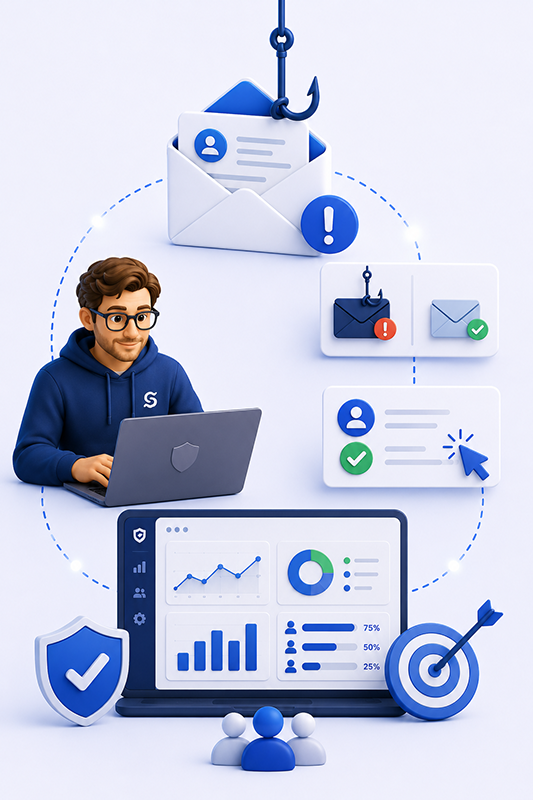

Insights into actual click behavior
How can you tell if employees are clicking on links?
From plan to implementation
How do you create a phishing campaign?
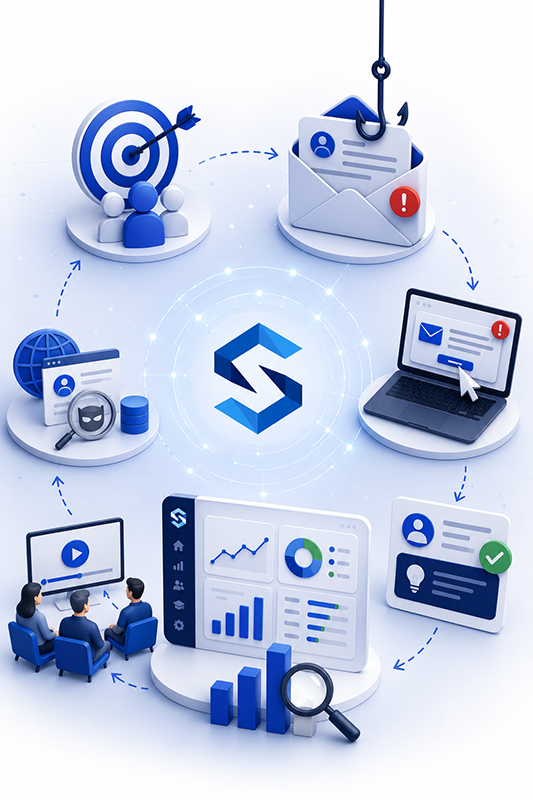
Always up to date, always automaticPhishing tests that work
We facilitate continuous employee training. Each month, a new phishing email is automatically deployed, selected from an extensive library of realistic scenarios. With over 30 distinct domains and difficulty levels ranging from Easy to Advanced, the training remains both varied and challenging, ensuring users continuously enhance their capabilities.
The simulations are designed as authentic emails – e.g., package delivery, invoices, HR/payroll, Microsoft 365/MFA, etc. Should an employee click, they are directed to a secure page providing immediate feedback, highlighting the specific warnings within that particular email and outlining recommended actions for future instances. Content is continuously updated, and annually we introduce new scenarios that align with current phishing trends and seasonal campaigns, ensuring the training always remains relevant and contemporary.

Why It WorksImpactful Simulations
Our phishing tests emulate the latest threats, enabling employees to recognize attacks in practice. Each simulation concludes with immediate feedback, transforming the experience into tangible learning without disrupting the workday.
While many solutions merely register that an employee clicked a link, SecureFirst provides immediate and constructive feedback.
The employee immediately understands why the email constituted an attack and which warning signs were overlooked. This learning approach is significantly more effective than general courses, as it occurs precisely at the moment the error is made. Thus, a potential weakness is transformed into a strength, and the likelihood of falling victim again significantly decreases.
Get Started InstantlyUnparalleled Simplicity
Once the platform is activated, we manage the entire process, eliminating the need for manual administration. With our integration, including Microsoft, users are automatically synchronized. This ensures easy onboarding and consistently updated user management for your organization.
Upon initiating phishing simulations, we guide you step-by-step through a concise onboarding process. During this, we assist with domain whitelisting and conduct a dashboard review, ensuring you fully comprehend how the graphs and reports illustrate your progress. This means that even after the initial meeting, you can monitor the evolution of employee behavior and observe tangible training outcomes – without additional administrative burden.

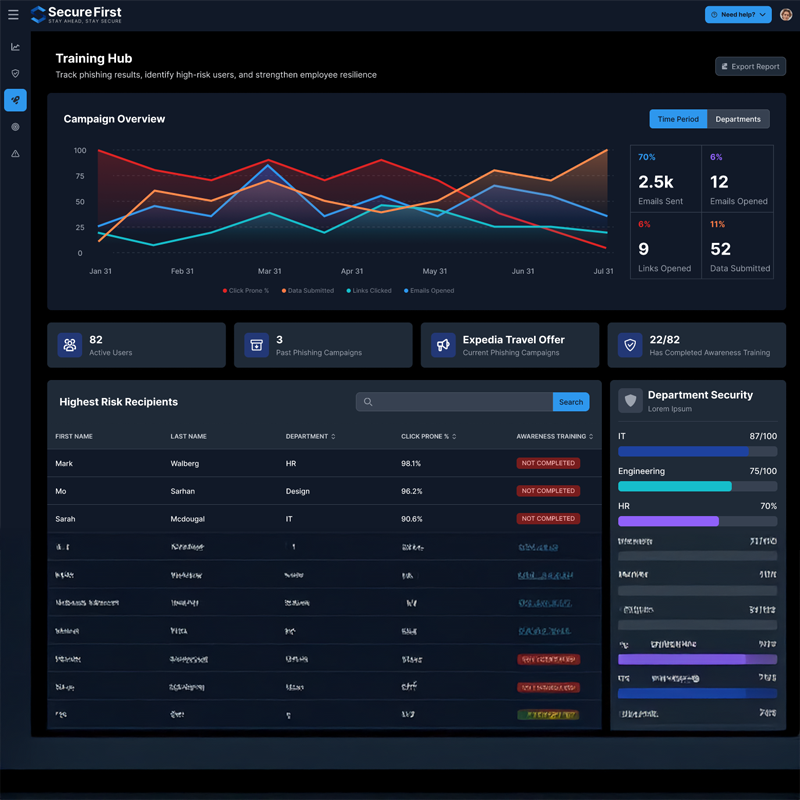
Monitor Your ProgressA Unified Overview
The SecureFirst portal provides a unified overview of your phishing simulations. Here, you can view click-through rates, track trends over time, and identify which departments or employees require additional attention.
Our dashboard not only displays general click-through rates but also allows you to drill down to individual employees, revealing their precise responses in each simulation. This provides unique insight into risk areas and enables targeted training, ensuring everyone receives support where it is most needed.
Many IT managers find that this transparency saves them time and facilitates communication with leadership, as they can document both challenges and tangible progress without generating manual reports.
Highly Rated by Users. Documented Effectiveness.
Employees perceive our simulations as realistic and appropriately challenging,
fostering learning and enhancing their ability to identify attacks.
-
 Simon
Simon
-
Henrik
-
Katrine
-
Jonas
-
Noah
-
Mia
-
Nanna
-
William
-
Phillip
-
Lene
-
Agnes
-
Thea
-
Line
-
Viktor
-
Julie
-
Maria
-
Sarah
-
Mads
-
Ida
-
Annika
-
Tobias
-
Anders
-
Rasmus
-
Camilla
-
Sofie
-
Christian
-
Caroline
-
Kasper
-
Alexander
-
Søren
-
Alma
-
Oliver
-
Daniel
-
Nadia
-
Gustav
-
Lucas
-
Trine
-
Signe
-
Jesper
-
Frederik
-
Mikke
-
Emilie
-
Louise
-
Laura
-
Emma
-
Sebastian
-
Martin
-
Niklas
-
Malte
-
Simon
-
Henrik
-
Katrine
-
Jonas
-
Noah
-
Mia
-
Nanna
-
William
-
Phillip
-
Lene
-
Agnes
-
Thea
-
Line
-
Viktor
-
Julie
-
Maria
-
Sarah
-
Mads
-
Ida
-
Annika
-
Tobias
-
Anders
-
Rasmus
-
Camilla
-
Sofie
-
Christian
-
Caroline
-
Kasper
-
Alexander
-
Søren
-
Alma
-
Oliver
-
Daniel
-
Nadia
-
Gustav
-
Lucas
-
Trine
-
Signe
-
Jesper
-
Frederik
-
Mikke
-
Emilie
-
Louise
-
Laura
-
Emma
-
Sebastian
-
Martin
-
Niklas
-
Malte
-
Agnes
-
Mia
-
Ida
-
Lene
-
Phillip
-
Alexander
-
Niklas
-
Signe
-
Alma
-
Søren
-
Emma
-
Kasper
-
Mads
-
Trine
-
Sarah
-
Daniel
-
Jonas
-
Mikke
-
Lucas
-
Tobias
-
Louise
-
Noah
-
William
-
Caroline
-
Gustav
-
Camilla
-
Jesper
-
Nadia
-
Emilie
-
Sebastian
-
Frederik
-
Nanna
-
Line
-
Anders
-
Malte
-
Maria
-
Julie
-
Simon
-
Thea
-
Martin
-
Sofie
-
Christian
-
Oliver
-
Katrine
-
Henrik
-
Annika
-
Rasmus
-
Viktor
-
Laura
-
Agnes
-
Mia
-
Ida
-
Lene
-
Phillip
-
Alexander
-
Niklas
-
Signe
-
Alma
-
Søren
-
Emma
-
Kasper
-
Mads
-
Trine
-
Sarah
-
Daniel
-
Jonas
-
Mikke
-
Lucas
-
Tobias
-
Louise
-
Noah
-
William
-
Caroline
-
Gustav
-
Camilla
-
Jesper
-
Nadia
-
Emilie
-
Sebastian
-
Frederik
-
Nanna
-
Line
-
Anders
-
Malte
-
Maria
-
Julie
-
Simon
-
Thea
-
Martin
-
Sofie
-
Christian
-
Oliver
-
Katrine
-
Henrik
-
Annika
-
Rasmus
-
Viktor
-
Laura
-
Gustav
-
Nanna
-
Tobias
-
Louise
-
Rasmus
-
Frederik
-
Mia
-
Daniel
-
William
-
Sebastian
-
Laura
-
Annika
-
Christian
-
Agnes
-
Julie
-
Trine
-
Noah
-
Katrine
-
Simon
-
Jesper
-
Sarah
-
Phillip
-
Malte
-
Camilla
-
Søren
-
Thea
-
Anders
-
Mikke
-
Signe
-
Mads
-
Ida
-
Emilie
-
Kasper
-
Maria
-
Alexander
-
Sofie
-
Henrik
-
Emma
-
Caroline
-
Nadia
-
Jonas
-
Niklas
-
Oliver
-
Martin
-
Line
-
Viktor
-
Lucas
-
Lene
-
Alma
-
Gustav
-
Nanna
-
Tobias
-
Louise
-
Rasmus
-
Frederik
-
Mia
-
Daniel
-
William
-
Sebastian
-
Laura
-
Annika
-
Christian
-
Agnes
-
Julie
-
Trine
-
Noah
-
Katrine
-
Simon
-
Jesper
-
Sarah
-
Phillip
-
Malte
-
Camilla
-
Søren
-
Thea
-
Anders
-
Mikke
-
Signe
-
Mads
-
Ida
-
Emilie
-
Kasper
-
Maria
-
Alexander
-
Sofie
-
Henrik
-
Emma
-
Caroline
-
Nadia
-
Jonas
-
Niklas
-
Oliver
-
Martin
-
Line
-
Viktor
-
Lucas
-
Lene
-
Alma
Try our phishing module – no commitment
Link to our privacy policy and terms.
Clients already secured with SecureFirst:





Need clarification?What other companies have asked

What is phishing simulation – and why is it important?
Phishing simulations are test emails designed to mimic real attacks. When employees encounter realistic scenarios in a secure environment, they learn to recognize threats in practice. This strengthens the organization's defense against one of the most prevalent attack vectors.
Is phishing simulation a requirement?
Yes, increasingly so. Many cyber insurance policies, NIS2, and customer requirements expect
companies to document that employees are trained to handle phishing attacks.
Simulations are the most effective way to achieve this.
How does SecureFirst's phishing simulation work?
We send automated phishing tests to employees monthly – from over 30
different domains. The difficulty level varies (easy, medium, hard), and each test concludes with immediate feedback, ensuring learning occurs in real-time.
How realistic are the simulations?
Highly realistic. Our tests emulate current threats without exposing
the organization to risk. Users perceive them as genuine emails, which makes the learning
process significantly more effective than theoretical instruction.
What happens if an employee clicks?
The employee lands on a page with immediate feedback, explaining the indicators of phishing in the email they just viewed. This makes the experience educational without being punitive.
Why do SecureFirst's phishing simulations provide superior learning compared to other solutions?
With many competitors, employees only receive feedback in a report long after they have been tested. At SecureFirst, they receive immediate feedback the moment they click. This means that learning occurs while the situation is still fresh in memory – leading to deeper comprehension and more lasting behavioral change.
Can we customize the simulations for our organization?
Yes. You can select languages, customize scenarios, or incorporate your own emails that reflect your
internal risks. This enhances the relevance of the training.
Can we document the effectiveness of the simulations?
Yes. The platform provides management reports with statistics on click-through rates, improvements over time, and the correlation between training and results. This facilitates easy demonstration of both impact and progress.
How can we verify its effectiveness?
Clients report a significant reduction in clicks on actual phishing emails within a short period.
The combination of continuous testing and immediate feedback has a documented impact on user behavior.
What is a phishing simulation?
A phishing simulation is a secure test in which employees receive realistic phishing emails without any actual risk. The purpose is to train them to recognize fake emails and provide the company with data on clicks, learning, and development.
Is phishing simulation legal?
Yes, companies can generally use phishing simulations as long as the test serves a legitimate security purpose, is conducted in a proportionate manner, and is properly communicated. The test should be used for learning purposes, not to shame employees.
What happens if an employee clicks?
With the SecureFirst platform, the employee is directed to a secure feedback page where the red flags in the email are explained. This turns the mistake into a learning opportunity.
How often should you conduct phishing tests?
Many companies find that they get the most value from ongoing phishing tests rather than a single annual test. This provides better insights, more reliable data, and evidence of progress over time.
Can phishing simulations demonstrate their effectiveness?
Yes. With our platform, you can track click-through rates, performance trends, completion rates, and reports, allowing you to demonstrate progress to management, the board, clients, or your insurance provider.
What are the costs?
You pay a fixed monthly price based on the number of employees. There are no hidden fees – and phishing simulations can be combined with awareness training to maximize effectiveness. Calculate a price using our price calculator. Try our price calculator to view pricing.

Combine Phishing Simulations with Data Breach Monitoring
Data breaches fuel phishing attacks. When threat actors gain access to email addresses, these are utilized for mass-distributed phishing campaigns. Our data breach monitoring detects leaked information promptly, enabling you to act swiftly and protect your organization from unauthorized access.